
Blog
How to Donate a Car: A Complete Guide to the Process and Tax Deduction Rules
Donating a car involves more than dropping off the keys: the charity you pick, the paperwork you keep, and the value the charity gets for the vehicle all determine what you can actually deduct. This guide walks through each step and the IRS thresholds that decide your deduction.
Donating a car sounds simple: find a charity, hand over the keys, take a tax break. The mechanics of the drop-off usually are simple. The tax rules attached to it are not, and most of the confusion comes from one fact people overlook: your deduction is almost always based on what the charity sold the car for, not what a used-car guide says it's worth.
This guide walks through the actual steps of donating a car, then breaks down the documentation and valuation rules the IRS attaches to the deduction. If you're donating a daily driver, the process is straightforward. If you're donating a classic, rare, or otherwise valuable vehicle that a charity plans to keep rather than sell, the rules (and the paperwork) change significantly.
Step 1: Choose a Qualified 501(c)(3) Charity
Your deduction only exists if the recipient organization is a qualified charity under the tax code. Most established nonprofits, including major vehicle donation programs, are recognized under section 501(c)(3), but it's worth confirming before you hand over a title. State-level consumer guidance, such as the Massachusetts guide to donating a car, recommends verifying an organization's charitable status before you donate, since a donation to a non-qualifying group produces no deduction at all regardless of the vehicle's value.
Ask the charity directly what it plans to do with the vehicle. Some organizations sell donated cars through auction partners, others repair and give them to families in need, and a few keep specialty or classic vehicles for their own use. As you'll see below, this decision drives which deduction rule applies to you.
Step 2: Transfer the Title and Get a Receipt
Title transfer is a state-law matter, not a federal tax rule, but it protects you from liability for parking tickets, tolls, or accidents involving a car that's no longer yours. Sign the title over to the charity or its authorized agent, record the odometer reading and date, and keep a copy for your records. Never leave the ownership field blank and never accept a charity's donation without completing this step, guidance echoed in the Massachusetts vehicle donation overview.
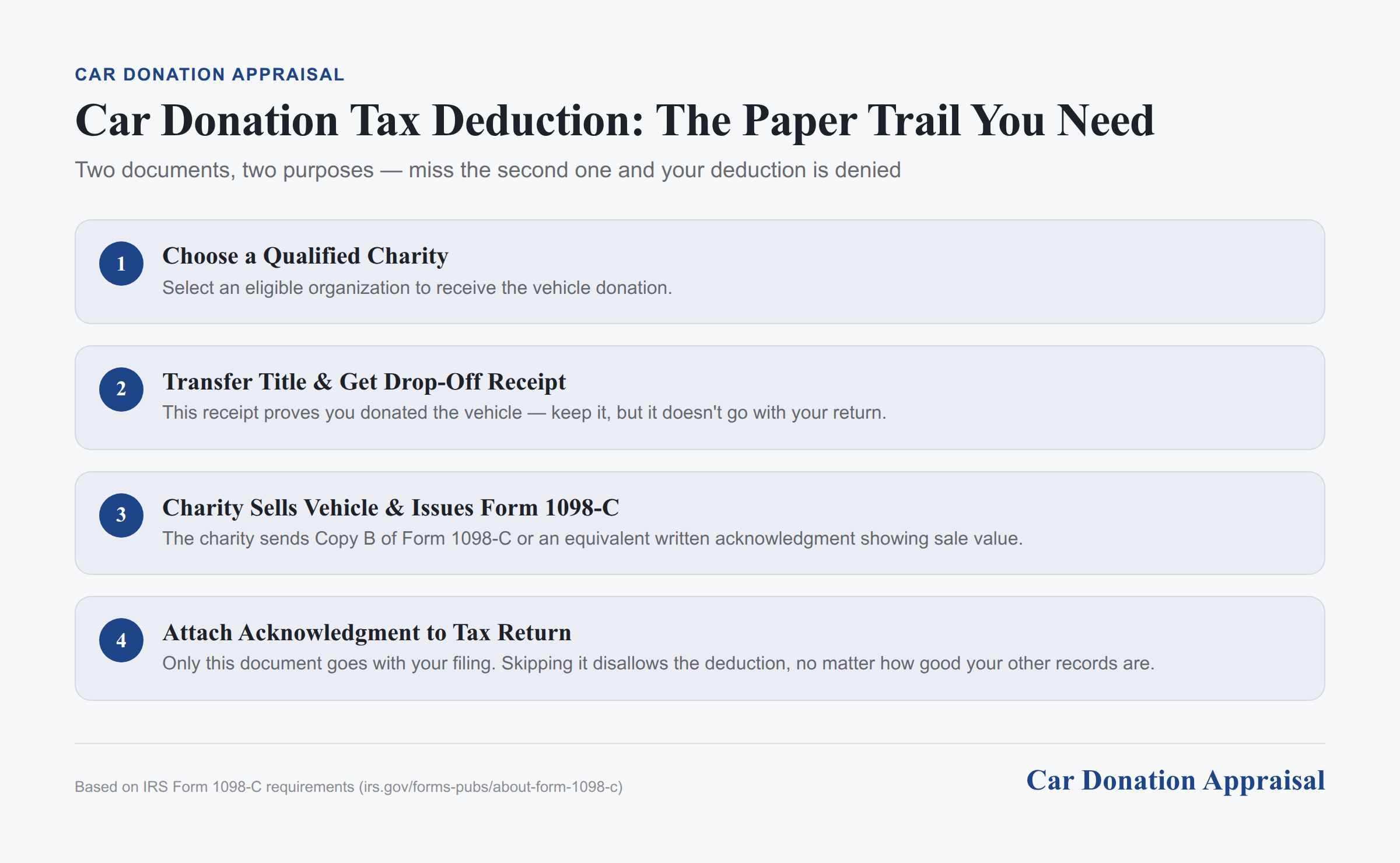
At drop-off (or pickup, if the charity arranges towing), get a receipt describing the vehicle and the date of the donation. This receipt is your first piece of paper trail. It is not the same as the acknowledgment the IRS requires for the deduction itself, which is covered next.
Step 3: Understand the Deduction Limits
The headline rule most donors don't expect: if the charity sells your car, your deduction is generally capped at the gross proceeds from that sale, not the fair market value you'd find in a pricing guide. This is the single biggest source of confusion in car donation, because most people assume they can deduct blue book value.
The IRS explains this limitation directly in its guidance on vehicle donation rules: once a charity sells a donated vehicle without using it or materially improving it first, your deduction is tied to what the sale actually brought in, which is frequently far less than the fair market value of the car.
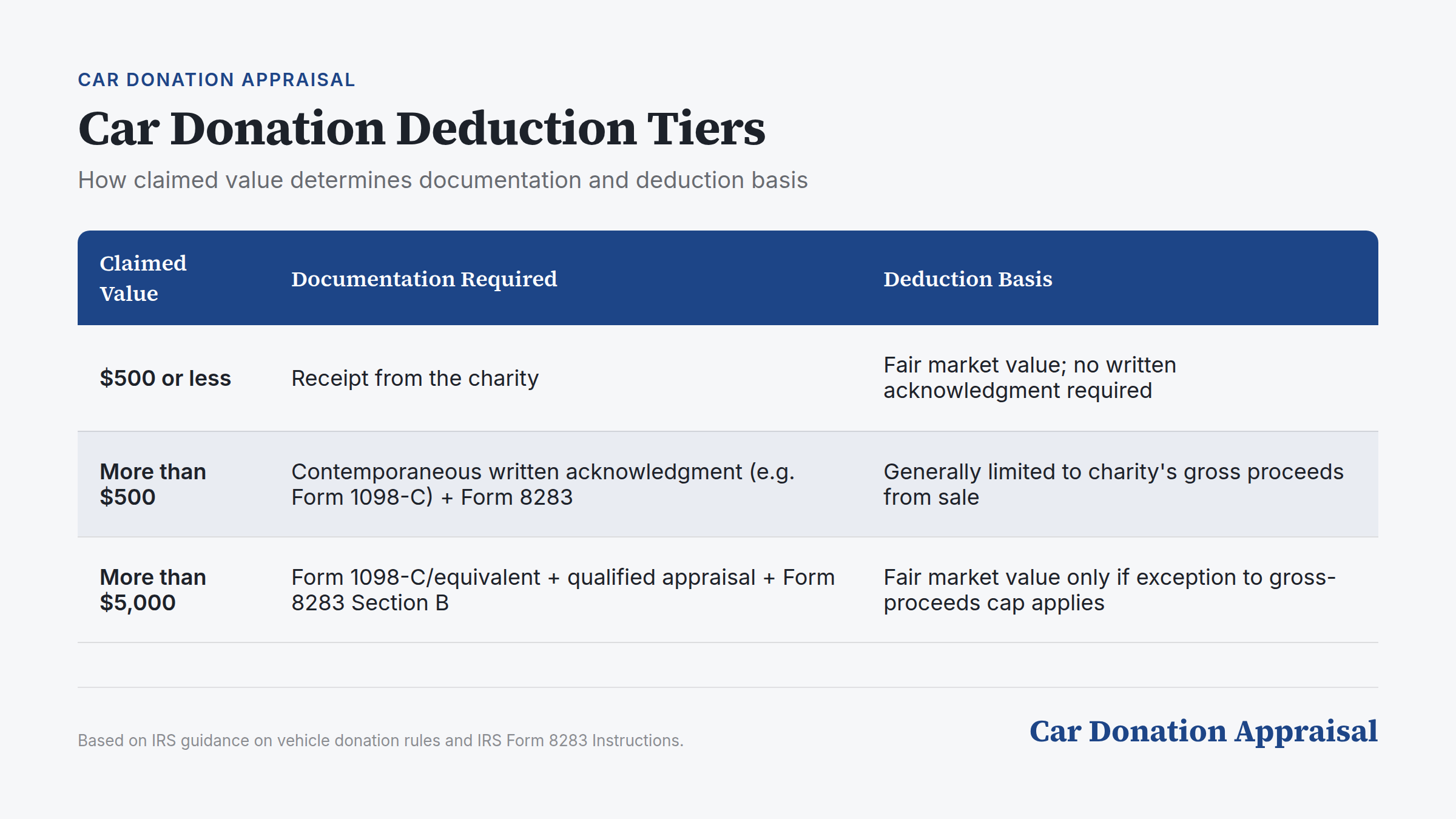
Here's how the claimed-value tiers work in practice:
| Claimed Value | Documentation Required | Deduction Basis |
|---|---|---|
| $500 or less | Receipt from the charity | Fair market value, no written acknowledgment required |
| More than $500 | Contemporaneous written acknowledgment (commonly Form 1098-C) attached to Form 8283 | Generally limited to the charity's gross proceeds from selling the vehicle |
| More than $5,000 | Form 1098-C or equivalent acknowledgment, plus a qualified appraisal and Form 8283 Section B | Fair market value, only if an exception to the gross-proceeds cap applies |
The IRS Form 8283 Instructions confirm that a deduction claimed above $500 requires this acknowledgment attached to your return, and that claims above $5,000 bring the qualified appraisal requirement into play unless the deduction is already capped at gross proceeds.
When Can You Deduct Fair Market Value Instead of Sale Price?
The gross-proceeds cap has real exceptions, and they matter most for donors giving away a valuable or unusual vehicle. Fair market value applies instead of sale proceeds when the charity does one of the following with the car rather than reselling it as-is:
- Uses the vehicle in its own charitable programs, such as a food bank using a donated van for deliveries.
- Gives it to a needy individual at a price significantly below fair market value, or gives it away outright, as part of the charity's mission.
- Makes material improvements to the vehicle before selling it, meaning repairs that go beyond minor fixes or cleaning.
IRS Publication 526 walks through these exceptions and requires that the charity's written acknowledgment specify which situation applies. This is the scenario that matters most for a donated classic car, an antique truck, or any vehicle a charity intends to keep and use rather than flip at auction. If you find yourself in one of these situations, how to value a donated car covers the valuation approach in more depth.
The $5,000 Threshold: Qualified Appraisals and Form 8283
If your vehicle qualifies for the fair market value exception and that value exceeds $5,000, the IRS requires a qualified appraisal along with Section B of Form 8283. This is where a used-car pricing guide is no longer sufficient documentation. The Form 8283 Instructions are explicit that claims above this threshold need a qualified appraiser's signed report attached to the return, not just a printout from a valuation website.
In practice, this situation is uncommon for everyday vehicle donations, since most cars donated to charity are resold quickly and fall under the gross-proceeds cap. It comes up almost exclusively with classic cars, rare or collector vehicles, and specialty trucks or equipment that a charity plans to retain. Our team prepares qualified appraisals and the Form 8283 support documentation specifically for these fair-market-value exception cases: a charity keeping a donated vehicle for its own use, or a high-value classic or collector car where the standard gross-proceeds cap doesn't apply. If you're arranging a car donation appraisal for a vehicle like this, it's worth scoping the appraisal before the donation closes, since the IRS generally expects the appraisal to be dated close to the contribution.
Watch out: Don't assume every donated vehicle needs an appraisal. If the charity is simply going to sell your car through its normal channels, your deduction is capped at the sale proceeds and no appraisal changes that outcome. An appraisal only matters when the fair-market-value exception is actually in play.
Our request a car donation appraisal page outlines what we need to prepare an IRS-qualified report for these situations. Fees for auto appraisals are quoted as a fixed price after scoping the assignment: standard reports start from $195, and IRS-qualified reports suitable for Form 8283 Section B start from $295, with complex or highly valuable vehicles running higher depending on research depth.
Filing Your Return: Attaching Form 1098-C
Once the charity sells your vehicle (or determines its fair market value if an exception applies), it's responsible for sending you a completed Form 1098-C or an equivalent contemporaneous written acknowledgment. You must attach Copy B of this form, or the substitute acknowledgment, to your tax return.
Miss this step and the deduction is disallowed outright, regardless of how well-documented your donation otherwise was. This is a frequent, avoidable mistake: donors assume the receipt from drop-off day is sufficient, file their return, and later find the deduction denied because the acknowledgment from the sale was never attached.
Key takeaway: Keep two separate documents. The receipt from drop-off proves you donated the vehicle. Form 1098-C (or its equivalent) proves what the charity did with it and what value applies to your deduction. You need both, and only the second one goes with your tax return.
Common Mistakes to Avoid
Most problems with car donation deductions come down to a handful of repeated errors:
- Deducting blue book value on a car the charity sold. Unless an exception applies, your deduction is the sale proceeds, not the guidebook price.
- Forgetting to attach Form 1098-C. The acknowledgment has to physically accompany your return, not just sit in a drawer as proof you have it.
- Skipping the qualified appraisal on a high-value exception vehicle. If the charity keeps a valuable car and you're claiming fair market value above $5,000, an appraisal isn't optional.
- Leaving the title incomplete. An unsigned or improperly assigned title can leave you liable for what happens to the car after you thought you'd donated it.
Car donation is a straightforward way to clear out a vehicle you no longer need while supporting a cause, but the deduction rules reward donors who understand which tier they fall into before they file. Know whether your charity is selling the car or keeping it, get the right paperwork at each step, and don't assume a pricing guide substitutes for a qualified appraisal once you cross the $5,000 threshold on a fair-market-value claim.
This article is provided for general informational purposes only and does not constitute legal, tax, or financial advice. Readers should consult a qualified attorney or CPA regarding their specific circumstances.