
Blog
Do I Need a Clear Title to Donate My Car, and What If I've Lost It?
Most charities require a clear, transferable title before they'll take your car, but a lost title doesn't end your donation plans. Here's what a clear title means, how to get a replacement before pickup, and how title status connects to your IRS deduction paperwork.
Why Charities Require a Clear Title to Accept Your Car
A charity generally needs a clear title before it can legally accept your vehicle. Without one, the organization has no reliable way to prove it owns the car, which makes it nearly impossible to transfer, sell, or dispose of the vehicle down the line. The IRS Donor's Guide to Car Donations treats title documentation as a basic building block of a legitimate donation, and most reputable charities won't schedule a pickup until that piece is settled.
The IRS doesn't set a single nationwide title-transfer procedure. Instead, IRS guidance on vehicle donations points donors and charities back to the title laws of the state where the car is registered. That's an important distinction: the charity's home state doesn't govern the paperwork, your state's motor vehicle agency does.
There's also a liability reason to get this right. Until the title is properly assigned out of your name, you can remain the vehicle's registered owner in the eyes of your state, even after the charity has hauled it away. That's why completing the transfer, not just handing over the keys, is the step that actually ends your responsibility for the car.
What Counts as a Clear Title
A clear title is one that names you (or every listed owner) as the legal owner, carries no unresolved lien, and can be signed over to the charity without extra steps. In practice, that means the vehicle identification number on the title matches the car, any loan against the vehicle has been paid off and released, and the assignment section is ready to be completed with the charity's name.
Requirements for finishing that assignment vary by state. Some states want notarized signatures, some require the odometer disclosure filled in a specific way, and some, like California, require the donor to also file a separate notice of transfer with the DMV within days of handing over the vehicle. If you've already looked into notifying the California DMV after a car donation, you know the title assignment and the DMV notice are two different filings; both matter, and skipping either one can leave old parking tickets or toll violations attached to your name long after the car is gone.
What If You've Lost Your Title? Steps to Get a Replacement
A missing title does not disqualify you from donating. It just means you'll likely need a duplicate title from your state's motor vehicle agency before the transfer can be finalized. The New York Attorney General's guidance on vehicle donations advises donors in this situation to contact the DMV directly, request a replacement, and keep copies of every document once the transfer is done.
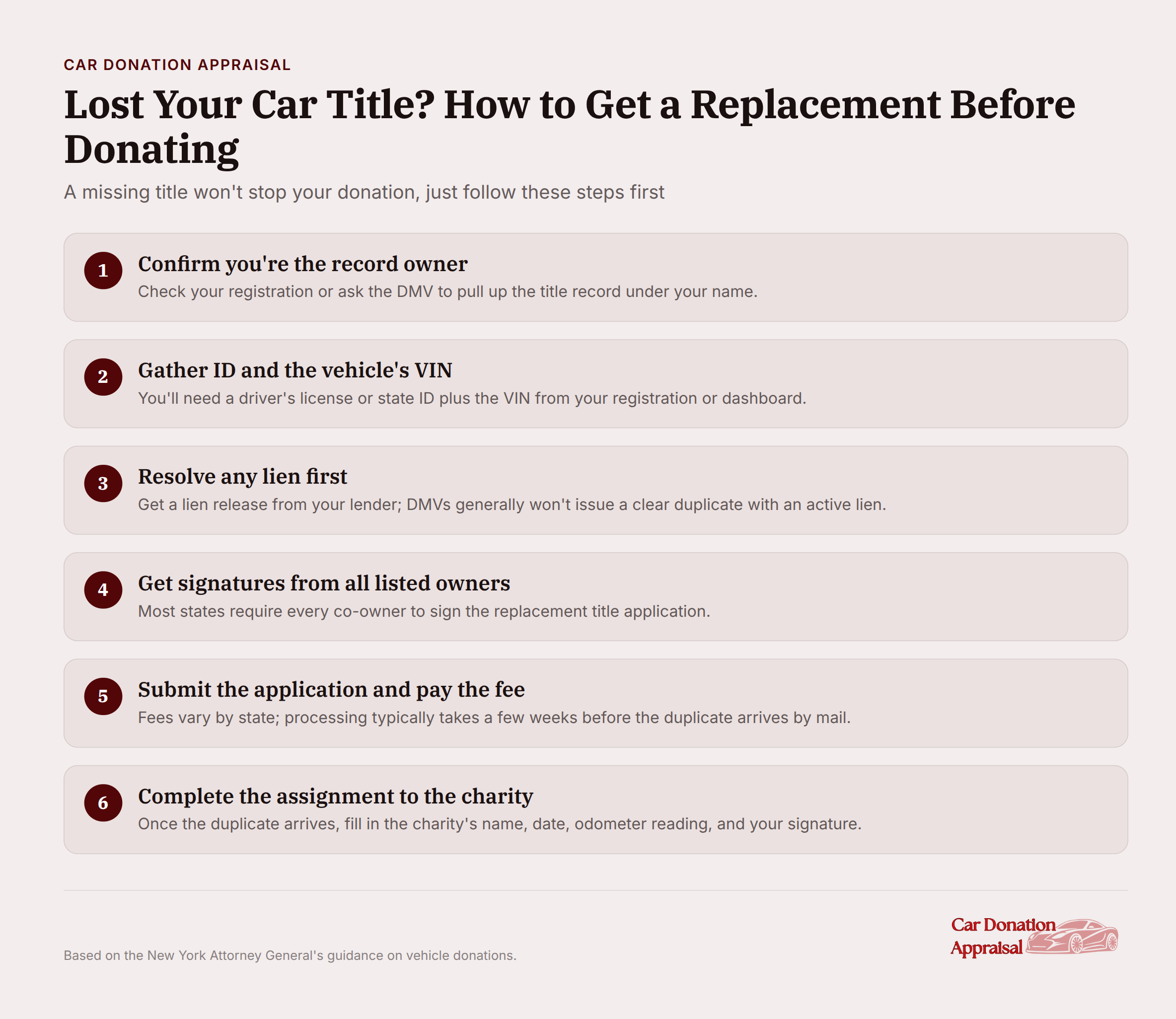
The general process looks like this in most states:
- Confirm you're the record owner. Check your registration or ask your DMV to pull up the title record under your name before you apply for a duplicate.
- Gather your identification and the vehicle's VIN. You'll typically need a driver's license or state ID plus the vehicle identification number, which is usually on your registration card or the dashboard.
- Resolve any lien first. If a lender is still listed on the title, get a lien release from them before or alongside your replacement title application; the DMV generally won't issue a clear duplicate while a lien is active.
- Get signatures from every listed owner. If the car is titled to more than one person, most states require all owners to sign the replacement application.
- Submit the application and pay the fee. Replacement title fees vary by state, and processing typically takes a few weeks before the duplicate arrives by mail.
- Complete the assignment to the charity once the duplicate arrives. Fill in the charity's legal name, the date, the odometer reading, and your signature exactly as your state's form requires.
A charity may agree in advance to schedule your pickup while the duplicate title is in process, but most will hold the paperwork, and sometimes the vehicle itself, until the title is in hand. Building a few extra weeks into your timeline avoids a stalled donation.
What If There's a Lien or Multiple Owners on the Title?
A title generally isn't considered clear while a lender is still listed on it. You'll need a formal lien release from the lienholder, which some lenders provide quickly and others take weeks to process, so it's worth requesting early if you know a loan was ever attached to the car. A federal review of vehicle donation programs found that inconsistent title and lien documentation was a recurring source of delay and confusion between donors and charities, which is exactly why getting the paperwork buttoned up ahead of pickup matters so much ().
Co-ownership adds another wrinkle. If the title lists two names joined by "and," both owners typically must sign the assignment. If it's joined by "or," a single signature is often enough, but this varies enough by state that it's worth confirming with your DMV rather than assuming.
Can a Charity Accept My Car Without a Title?
In limited cases, yes, but it's the exception, not the rule. Some charities will accept alternate proof of ownership, such as a bill of sale combined with a notarized affidavit, particularly for older vehicles being sold for scrap or parts rather than resold at retail. Even then, most organizations treat this as a fallback for situations where a duplicate title genuinely can't be obtained, not a routine substitute.
A clear title remains the standard and the safest path for both sides. It protects you from lingering liability, it gives the charity a clean chain of ownership to work with, and it keeps your paper trail intact if the IRS ever asks questions about your deduction.
Watch out: Don't sign a title over to a charity and assume you're finished. Keep a copy of the signed assignment and, where your state requires it, file your own notice of transfer or release of liability. That's your proof the car left your name on a specific date.
How Title Status Affects Your Tax Deduction
Title transfer and tax deductibility are two separate issues, but they're connected through documentation. A clean title transfer helps establish when the donation happened and confirms the charity actually received the vehicle, both of which matter once you get to the deduction paperwork.
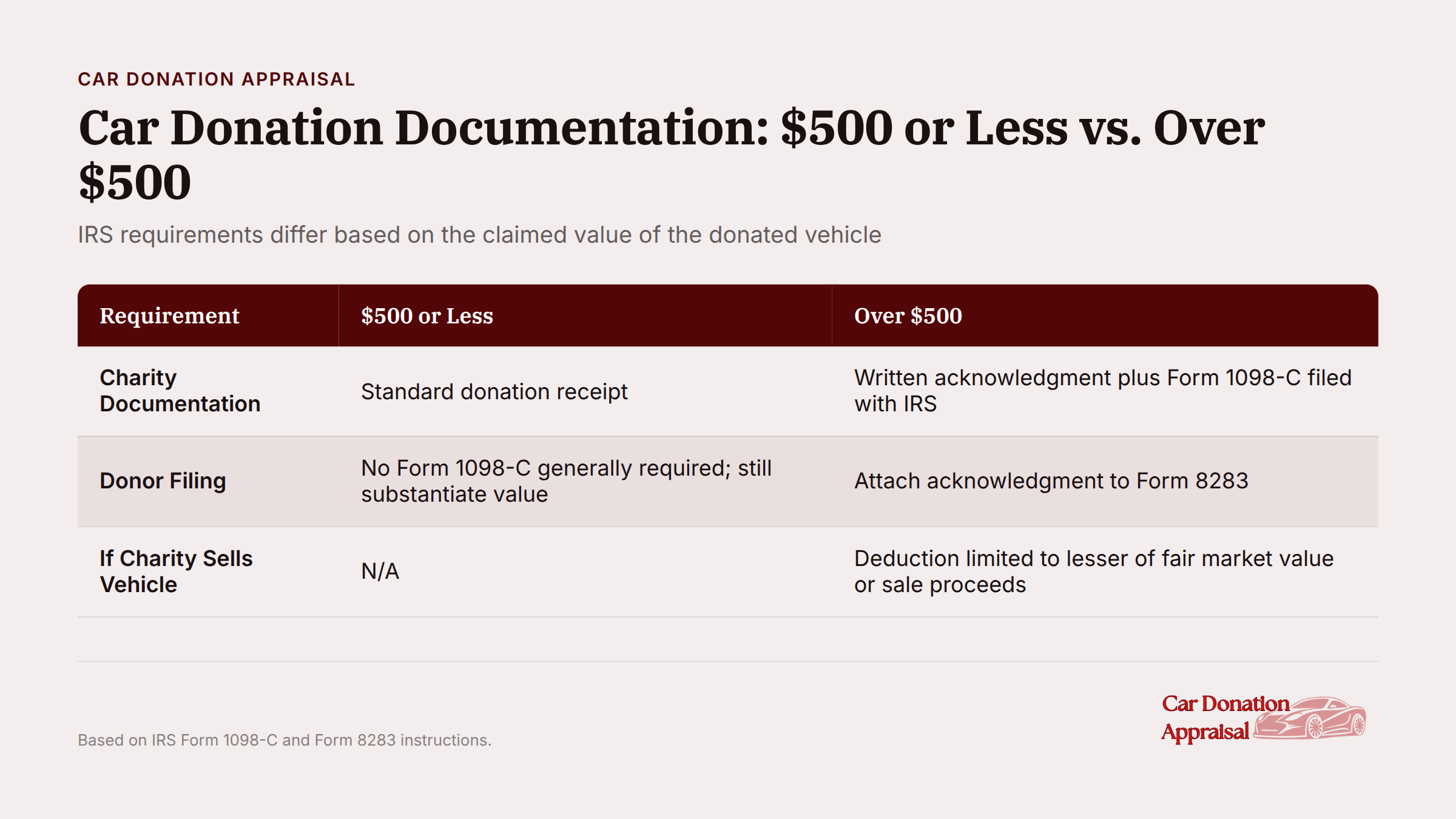
For a claimed value over $500, the charity is generally required to send you a contemporaneous written acknowledgment and file Form 1098-C, Contributions of Motor Vehicles, Boats, and Airplanes, with the IRS. You then generally need to attach that acknowledgment when you complete Form 8283 for noncash charitable contributions. If the charity later sells the car rather than using or improving it, your deduction is typically limited to the smaller of the vehicle's fair market value or the actual sale proceeds, a nuance covered in more detail in our guide to Form 8283 for car donations.
| Claimed Value | Charity Documentation | Donor Filing |
|---|---|---|
| $500 or less | Standard donation receipt | No Form 1098-C generally required; still substantiate value |
| Over $500 | Written acknowledgment plus Form 1098-C filed with IRS | Attach acknowledgment to Form 8283 |
Key takeaway: A missing title can slow your donation down, but it rarely stops it. Getting a duplicate title, resolving any lien, and keeping the paperwork organized protects both your legal standing as the former owner and your ability to substantiate the deduction you claim.
Ready to Move Forward
Whether your title is in hand or you're a few weeks out from a replacement arriving in the mail, it's worth lining up your documentation before the tow truck shows up. If you're weighing your options or want help understanding what your donation could be worth, request a car donation appraisal and we'll walk you through exactly what you need.
This article is provided for general informational purposes only and does not constitute legal, tax, or financial advice. Readers should consult a qualified attorney or CPA regarding their specific circumstances.